Studying Fungal Vulnerabilities to Improve Future Treatments


Fungal Disease Awareness Week is an opportunity to shine a light on diseases that can be overlooked, but for researchers at Touro University Nevada, understanding fungal infections is a year-round pursuit.
Dr. Brad A. Haubrich, PhD, and Touro Nevada osteopathic medical student researchers study disease-causing fungi with a long-term goal of contributing to better ways of understanding and treating fungal infections and, ultimately, improving patient outcomes.
An emerging focus of Dr. Haubrich’s group is fungal metabolism, particularly the processes fungi use to maintain nicotinamide adenine dinucleotide (NAD), a molecule essential for energy production and numerous cellular functions. By understanding how fungi maintain the right amounts of NAD, a process known as NAD homeostasis, the group is exploring whether these pathways contain vulnerabilities that could be exploited for antifungal drug discovery.
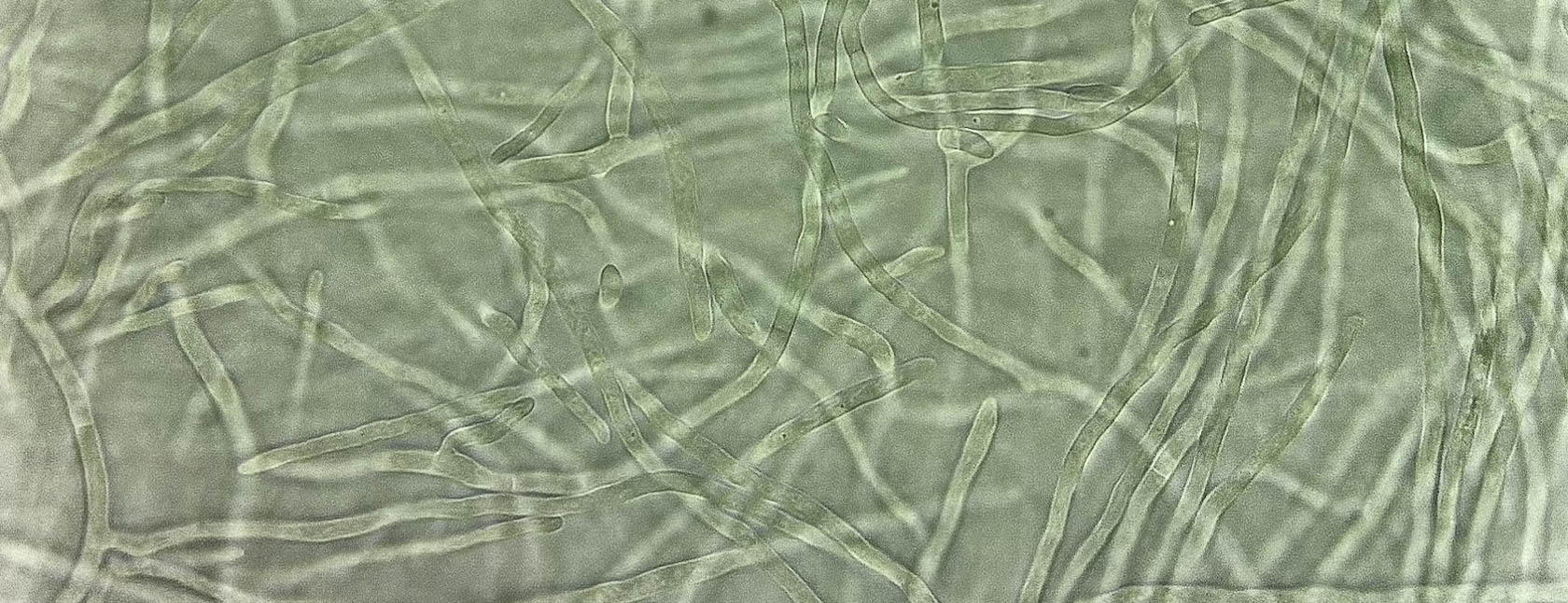
One part of this research examines how disrupting fungal metabolism affects the growth and behavior of whole cells. The group has been developing this work in Candida, a group of yeasts that can cause infections ranging from common mucosal infections to serious invasive disease, as well as Mucor circinelloides, a mold that can cause mucormycosis.
In Candida parapsilosis, DO27 medical student and MHS graduate Travis Tran worked with Dr. Haubrich’s group to characterize nicotinamide mononucleotide adenylyltransferase (NMNAT), an enzyme that helps produce NAD, with the goal of identifying compounds that could block this process. Travis was awarded a Touro University Nevada Student Fellowship for the work, and collaborated with fellow medical students Hamza Naqvi DO 27 and Nikita Deng DO29. Portions of their findings were presented to global audiences at Pacifichem and at the annual meeting of the International Chemical Biology Society.
A related project examines NAD homeostasis in Mucor circinelloides, bringing together questions about fungal metabolism with the practical challenges of studying a filamentous mold. Lara Derderian and Christian Kalekas, DO30 medical students and MHS graduates, are developing methods to measure fungal growth more consistently while investigating how disruption of metabolic pathways affects the organism. Because Mucor grows very differently from yeast-like fungi and produces abundant spores, the project has required the medical students to develop reliable experimental approaches before they can tackle more complex biological questions. This work illustrates an important part of biomedical research: sometimes researchers must first figure out how to reliably study an organism before they can ask deeper questions about its biology.
Together, these projects address a common question: how do fungal cells maintain NAD homeostasis, and are there parts of that system that differ enough from human biology to serve as targets for future antifungal drugs? Dr. Haubrich’s group approaches that question at multiple levels, from microscopy and phenotypic drug discovery (PDD) in living fungal cells to biochemical studies of individual enzymes and target-based drug discovery (TDD). This combination allows researchers to connect what happens to the whole organism with what happens at the molecular level, helping students understand how observations made in one type of experiment can generate questions for another.
For the medical students involved, these projects provide an opportunity to contribute to an emerging area of fungal biology while learning how biomedical research progresses from observation to hypothesis and discovery. Kalekas shared, “I never expected to be doing hands-on research involving fungi, but it's been such a rewarding experience. I've enjoyed learning how fungi like Mucor and Candida grow under specific conditions and how they can impact human health. This experience has also shown me how delicate yet unpredictable these organisms can be. It's been exciting to work on these projects, not only because I understand how this research can make a difference in the community, but also because of how much work still needs to be done in this area of medicine and the endless possibilities for treatment that come with it.”
By combining studies of whole fungal cells with investigations of individual enzymes, Dr. Haubrich's group is working to better understand how fungi regulate NAD homeostasis and whether these pathways may reveal new opportunities for antifungal drug discovery. As fungal diseases continue to emerge as an important global health challenge, this work contributes to the broader effort to identify new strategies for preventing and treating fungal infections.
